Why Is Corned Beef From Brazil
JBS has faced multiple corruption charges, complicity in modern-twenty-four hour period slavery and was fined $8m in 2017 for illegal Amazon deforestation yet leading supermarkets continue to stock its corned beefiness products
Sainsbury's, Asda, Lidl and Carrefour are among the international brands potentially fueling illegal deforestation in Brazil's cattle industry every bit they keep to stock corned beef from a firm implicated in numerous environmental and human rights abuses.
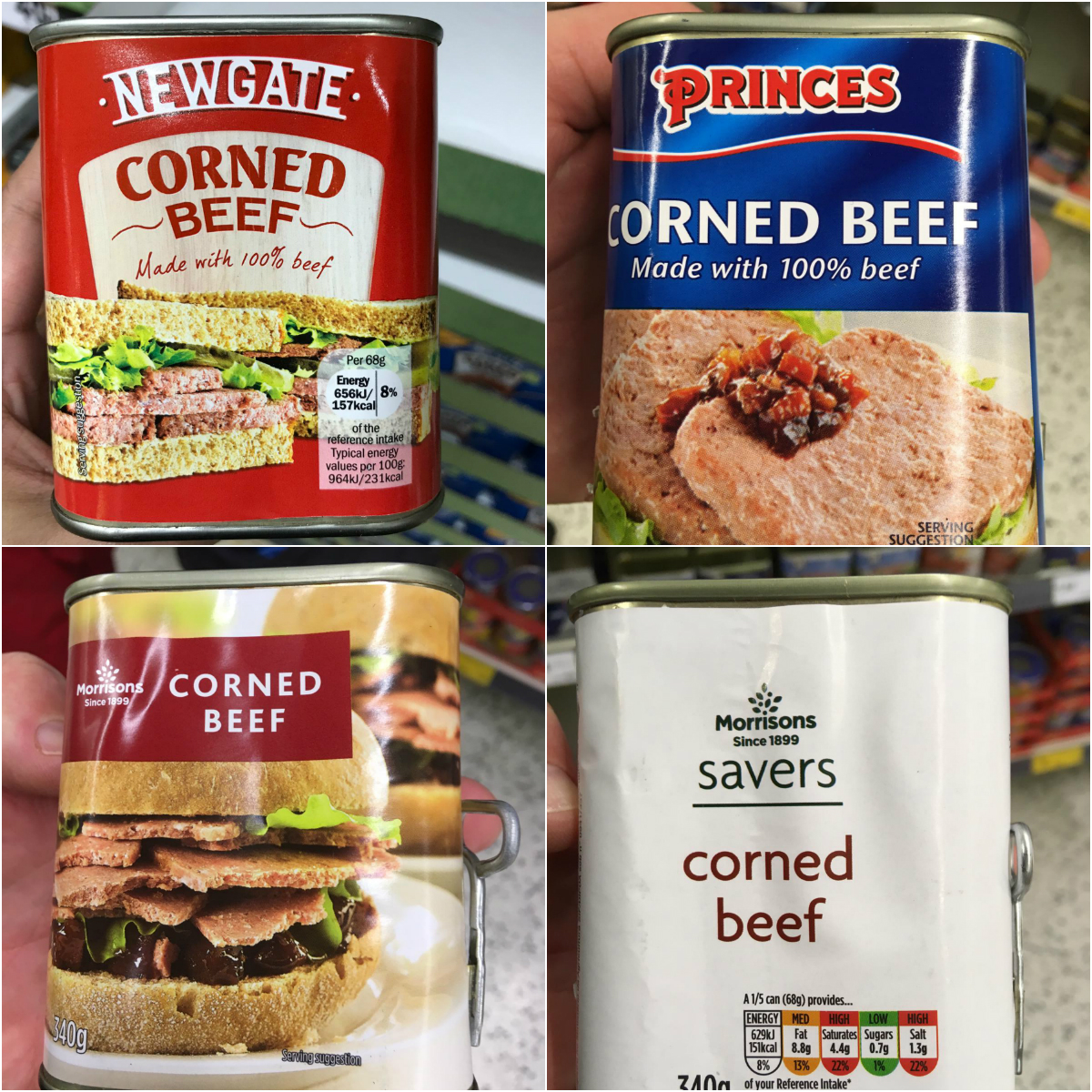
A new Earthsight investigation exposes how scandal-hit Brazilian business firm JBS, the world's largest beef producer, is supplying United kingdom and European supermarkets with corned beef products for their own brand products and via UK firm Princes, the Lebanese-owned Exeter brand and Italian brand Simmenthal.
Earthsight researchers plant Great britain retailers Morrisons and Lidl source JBS beefiness for their own brands of corned beef, while Sainsbury's and Asda stock Exeter and Princes corned beef supplied by JBS. Meanwhile, pop Italian brand Simmenthal uses JBS for its tinned products in supermarkets nationwide including in French behemothic Carrefour, which also stocks the product in its Belgian stores.
With Brazil currently experiencing decade-high levels of wood loss and Jair Bolsonaro's far-correct government intent onundermining environmental protections, European retailers questionable buying practices hazard amplifying woods destruction in the Amazon, where over 60 percent of deforested lands are used for pasture.
The readiness of major brands to proceed stocking JBS beef is a worrying trend. The house, whose sometime executives were implicated in Brazil'due south seismic Operation Car Launder abuse case in 2017, has been long-mired in scandal.
In 2017 JBS was establish guilty of illegal deforestation in the Amazon and fined R$24.vii million ($eight million). The same year Brazil's Federal Constabulary said the house bribed government to falsify expiration dates on its processed meat which was later sold domestically and overseas, while cattle farms used past the business firm have been defendant of modernistic-day slavery. New illegal deforestation or bribery scandals involving JBS have emerged every few months since. About recently, in March 2019 prosecutors called on the firm to pay R$iii.7 billion ($970 million) bounty for securing a series of fraudulent loans.
Sam Lawson, Earthsight managing director, said: "Grand corruption, modernistic slavery, illegal deforestation, tainted meat. You have to wonder what a supplier would have to do to go dropped by these supermarkets. The extent to which they proceed to prioritise profit over principles is shocking. It is doubtful their customers would make the same choices when presented with the same facts."
European demand soars
Alarmingly, ambition for beef from the Sao Paulo-headquartered firm, which has 350,000 staff in xvi countries and posted revenues n of $180 billion Reais ($46 billion) in 2018, is growing.
Its corned beef imports to the UK striking an estimated £42 million ($54 million) in 2018 – a almost 25 per cent rise on the previous year – and Bolton Alimentari, makers of Simmenthal, imported 2600 tonnes in 2018, making it JBS's third largest European importer.
The United kingdom, Italy, the netherlands, Belgium and Espana bought almost xc percent of JBS's 55,000 tonnes of European beef exports in 2018, Earthsight assay of international merchandise data shows. Meanwhile, UK corned beef imports totalled 28,550 tonnes last year, 95 per cent of which came from Brazil and nearly one-half from JBS.
Earthsight'southward researchers found different varieties of Princes corned beefiness supplied by JBS at Sainsbury's, Asda and Morrisons. 2 of Morrisons's own make products are made with JBS produce, while some others are vaguely labelled every bit sourced from 'South American' beefiness. Earthsight approached Morrisons for clarification but did not receive a reply before publication.
JBS likewise supplies the beef used in Simmenthal, an Italian household tinned beefiness brand stocked by all major supermarkets in the country. Among them is French-owned Carrefour, one of the largest supermarket chains in the world, with over 12,300 stores in more than than 30 countries. Earthsight researchers also found the production stocked in Carrefour stores in Belgium.
This burgeoning presence in the UK and Europe is a snapshot of the company's exponential growth in contempo years.
Brazil's government sees JBS – which alongside beef, exports leather, pork and chicken to over 150 countries – as a national champion and the house has benefitted from billions of dollars in subsidised loans from the state, helping it get one of the world's largest food companies every bit revenues have ballooned 42-fold between 2006 and 2016.
Such growth and international reach – JBS now owns popular U.s.a. brands Pilgrim'due south and Swift – is offset by a dubious environmental tape and a string of blackmail allegations and illegal action which has engulfed the firm.
Illegal deforestation practices
Allegations of links to illegal deforestation in Brazil accept plagued JBS for over 10 years. In one specially notable recent case, in 2017 ii JBS-owned slaughterhouses bought nearly l,000 heads of cattle from ranches guilty of illegal deforestation in the Amazon. The visitor was fined R$24.seven meg ($8 million).JBS denied wrongdoing and told Reporter Brasil, a news agency, at the time that "the company does not buy livestock from ranches that practice illegal deforestation"
The same year it was revealed that JBS had been buying thousands of heads of cattle from a farm endemic past a notorious Brazilian cattle rancher known equally Jotinha, who was arrested in relation to a massive illegal deforestation instance in 2016. JBS bought R$five.9 million ($2.5 one thousand thousand) in cattle between 2013 and 2014 from Jotinha'due south farms in Pará, northern Brazil – he is believed to be the unmarried largest deforester in the Amazon's history. His farms have also beensanctioned past Brazilian authorities for employing workers in conditions coordinating to slavery.
The slavery revelations, first published past The Guardian and Reporter Brasil, led to British supermarket chain Waitrose removing all JBS corned beef products from their stores in 2017. Marks & Spencer also stopped stocking corned beef from Brazil in 2016.JBS told the Guardian it ceased purchases from the farm as before long as the slavery data became public.
Furthermore, in December 2018 it emerged that JBS hadallegedly sourced cattle from atleast four illegal farms operating at the Jaci-Paraná Extractive Reserve in the state of Rondonia, a protected area where large-scale cattle ranching is banned past federal law.
JBS has also reportedly purchased cattle from six farms located less than 10km from the reserve, which ways they could potentially be laundering illegal cattle for farms at Jaci-Paraná. Illegal large-calibration ranching at Jaci-Paraná has reportedly wiped out nearly half its forests. In an email sent to Brazilian news organization O Eco at the time, JBS alleged that the farms' locations on their tracking organization had been incorrect. The visitor also claimed that it had been working to correct this mistake on its database.
JBS said in 2017 that it stopped ownership from Jotinha'due south subcontract after learning of the illegalities and that it does not buy beef from any farms associated with slave labour.
A web of corruption
The illegal farming activity of several JBS suppliers is complemented past a serial of corruption cases which have dogged the firm in contempo years. 2017 was a specially bad year as alongside the high-profile Jotinha revelations, it emerged that JBS had been bribing sanitary inspectors to allow rotten meat to exist sold in Brazil and abroad, The revelations of Performance Weak Meat, as the relevant enforcement operation was known, led the US and other countries to temporarily suspend meat imports from Brazil.
Bribery cases involving JBS stretch far across industry insiders though and reach into the highest echelons of Brazilian society. In May 2017 JBS was implicated in Functioning Car Wash, one of the largest corruption scandals in Latin American history.
JBS admitted to having made illegal entrada donations to 1,829 candidates from 28 political parties over a menses of more than than ten years in render for favourable policies in one case candidates were elected. In total, nearly R$600 million ($250 million) was donated. J&F Investimentos, JBS's controlling shareholder, agreed to pay a R$10.3 billion ($3.2 billion) fine for JBS'southward role in the scandal, the earth'south largest leniency fine ever levied.
The revelations led the Batista brothers, Joesley and Wesley – who own 42 per cent of JBS – to plow informants. They entered a plea deal with prosecutors and turned in explosive recorded conversations with then Brazilian president Michel Temer revealing their bribing of regime officials. Joesley reportedly told Temer he was paying hush money to House Speaker Eduardo Cunha – now serving a prison sentence – in order to purchase his silence on illegal dealings involving JBS. Temer allegedly replied with "You take to keep information technology going, OK?".
Temer's own dealings with JBS were besides exposed and in March 2019 a Brazilian court accepted criminal charges against Temer presented by a federal public prosecutor in connection with the instance. Temer is thought to have received as much as R$38 million ($12 meg) in bribes from JBS.
Joesley and Wesleywere arrested in September 2017on split up insider trading charges relating to the plea agreement. Wesley was released in February 2018 and Joesley a calendar month later. In Nov 2018 police arrested Joesley overbribes allegedly paid by the Batistas and JBS to ministers and other politicians to obtain changes to regulations nearly the export of animal carcasses and the use of a parasite medicine. A judge ordered his release three days later.
JBS'southward dealings with the BNDES – Brazil's public development bank – have besides come under intense scrutiny. In March 2019, the land'due south federal prosecutors accused Joesley Batista and several loftier-ranking politicians of facilitating a serial of fraudulent loans to JBS from the public bank. The loans, earmarked for JBS'due south international expansion and approved in contravention to the bank'south rules, acquired a loss of R$1.8 billion ($470 million) to BNDES. Prosecutors are now demanding JBS pay R$3.vii billion ($970 meg) in compensation.
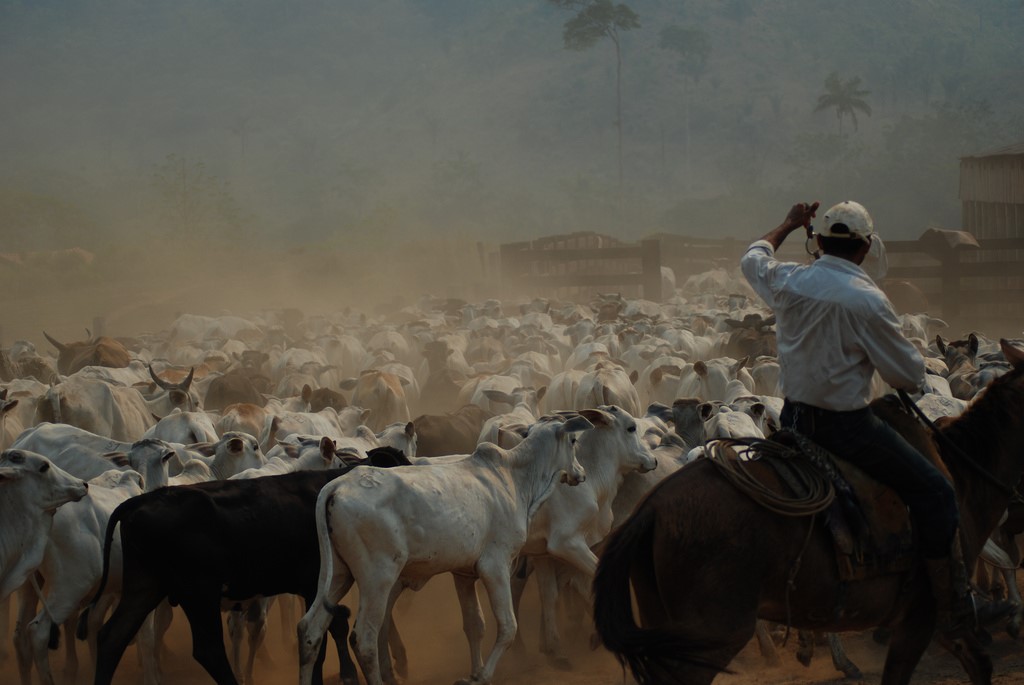
Cattle ranching in Para state, Brazil.
Opaque audits
Corruption and illegal deforestation charges may have mounted in recent years, but JBS'due south ain compliance documents would accept you believe they are Brazil'due south benevolent meat-packers.
Audits deputed by JBS since 2013 as part of agreements with various state prosecutors aimed at improving supply chain transparency (the 2009 Meat TAC agreement with the Amazon land of Pará where all major meat producers must monitor suppliers and agree to stamp out illegalities is a notable instance) advise the firm is a shining example of compliance.
The ii latest available audits, covering 2016 and 2017, indicate that over 99 percentage of JBS's cattle purchases comply with environmental and labour laws.
Withal, when the public prosecutor'due south function in Pará commissioned its own audits of large meat producers, including JBS for 2016, a strikingly different picture emerged.
The audit, devised nether the Meat TAC agreement and published in 2018, said JBS was one of the worst performing meatpackers in the land during 2016.
It showed that the business firm had bought over 118 g heads of cattle – or 19 percent of its full purchases in Pará – presenting some form of irregularity, including purchases from farms which didn't have the mandatory Rural Ecology Cadastre certificate needed to sell to slaughterhouses. Minerva, i of JBS's chief competitors, showed 0.1 per cent of irregularities. Most shockingly, 14 per centum of the total cattle purchased by JBS in Pará that year were found to have come from illegally deforested areas.
Princes told Earthsight its Brazilian beef "must come up from suppliers that undertake and publish annual independent audits" to guarantee no purchases are fabricated from farms that accept committed illegalities. How information technology tin continue to rely on such audits in spite of the recent findings from Pará is unclear.
Princes as well stated it continually reviews its relationships with all suppliers, including JBS, and that it does not source any products from the specific JBS sites that have been called into question by Earthsight's investigation. However, a policy focused on but excluding certain JBS slaughterhouses or suppliers rather than seriously assessing the visitor's overall record is somewhat brusk-sighted.
The JBS corned beef Earthsight institute on British supermarket shelves did come from the visitor's slaughterhouses in the state of Sao Paulo. Though they are far from the Amazon and take all the same to exist directly implicated in forest scandals, these slaughterhouses are shut to other Brazilian forest biomes where illegal deforestation for cattle-ranching is common.
In the lite of JBS's appalling track record, to merely assume that these slaughterhouses are 'clean' because they accept even so to be found otherwise looks like a convenient and wilful compromise that leaves consumers exposed to levels of risk they are unlikely to be comfortable with.
It also ignores the abuse issues surrounding JBS, about which Princes, Sainsbury's and Carrefour chose not to annotate in their responses to Earthsight'south findings.
Sustainable sources?
In comments sent to Earthsight, Carrefour has said the company is committed to achieving zero deforestation in its supply chain by 2020 and that information technology is "reaching out to the manufacturers producing the items [mentioned hither], in order to discuss with them their sourcing policy." Carrefour also noted JBS's annual audits of its supply chain, outlined above, every bit evidence of the firm'due south good practice.
Again, these companies' over-reliance on JBS'southward commitments and audits seem misguided when confronted with the available prove.
It is noticeable that in its answer to Earthsight, Carrefour alluded to JBS's 2009 agreement with Greenpeace as part of the visitor's sustainability commitments. Carrefour also stated that it is "closely post-obit JBS in its implementation of [its commitments], in shut dialogue with relevant NGOs and experts in Brazil." This seems to betoken that Carrefour has failed to keep upwardly with the latest news, including the fact that Greenpeace, who had been in discussions with JBS well-nigh its supplier monitoring and transparency, walked out of those talks in frustration more than two years ago.
Sainsbury's has told Earthsight that it is "committed to ensuring our own-brand products will not contribute to global deforestation by 2020. We've already fabricated significant progress and geographically restrict the sites we source from in Brazil." Sainsbury's did not explain why this ethical delivery does not apply to other brands it chooses to sell.
Meanwhile, deforestation in Brazil is increasing, with decade high levels of deforestation documented in 2018 and further rises documented in early 2019. Brazil slaughtered nearly 32 million heads of cattle in 2018, the highest level since 2014 and cattle ranching remains one of the nearly destructive activities for Brazil's forests and a central driver of deforestation.
The case for European regulation
It is unclear whether the specific cans of JBS corned beef filling supermarket aisles in the UK and Europe contributed directly to the destruction of Brazil'south forest ecosystem, merely in maintaining relations with a company and then complicit in recent deforestation and malpractice, retailers are diminishing their own upstanding and sustainable mantras.
It is evident that European retail giants who continue to sanction the auction of JBS corned beefiness products are in danger of deepening Brazil'southward deforestation epidemic.
Even if European buyers could be 100 per centum sure that their own purchases were non of suspect origin, they would still be helping support a company involved in doubtable practices. Well-nigh of their customers would probably expect them to disassociate entirely from such a company.
What'southward more, alternative lower-take chances options are bachelor, at little or no extra cost. M&S, for example, has introduced DNA sampling across its beefiness supply chain, allowing information technology to trace all its beef back to individual farms and animals. It besides currently stocks only British-produced corned beef. Meanwhile, Princes too produce an identical product made in France, which sells in supermarkets for the exact aforementioned price; Sainsbury'due south own-make Brazilian corned beef comes from a JBS competitor in Brazil with a much meliorate record and however is cheaper, while Morrisons also stocks British corned beefiness products.
Yet the connected promotion of a company with such a chequered record of environmental and financial corruption by some remains. Earthsight'south analysis suggests that the JBS beef sold by the firms we have identified is just the tip of the iceberg. Comparison of individual shipment records and Eu import data advise that JBS in Brazil is supplying one fifth of Europe's global beef imports.
A long history of examples such equally this i have led campaigners and parliamentarians beyond Europe to conclude that the but way to prevent Eu consumers from unwittingly contributing to overseas deforestation – including illegal deforestation – is through government regulation. An EU law already exists which requires importers of timber to ensure their woods is legally sourced, and there are growing calls for like legislation to be enacted for other 'woods take a chance commodities' like beef.
Nicole Polsterer, Sustainable Consumption and Production Campaigner at Fern, the forest and rights NGO, said: "It is unacceptable that JBS – a company fined for illegal deforestation – can keep to place beefiness on the EU marketplace. This is farther proof that the forthcoming EU Communication on Stepping Up Action to Halt Deforestation must advise legislation to ensure Eu companies and their suppliers do no environmental and social harm."
The EU and the UK take recognised the demand for action to reduce the bear on of their consumption on tropical deforestation, merely the latest indications are that the economic bloc is leaning towards a non-regulatory approach, entrusting companies to act voluntarily. This has elicited business organisation from NGOs.
In the meantime, we can just promise consumers volition now think twice before buying potentially bad beef.
Earthsight contacted JBS about our findings just received no reply before publication. Lidl, Bolton Alimentari, Targeter (producer of the Exeter make) and Morrisons were all approached for comment but Earthsight received no response at the time of publication.
brownblittion1949.blogspot.com
Source: https://www.earthsight.org.uk/news/idm/brazil-corned-beef-jbs-uk-supermarkets-deforestation-amazon
0 Response to "Why Is Corned Beef From Brazil"
Post a Comment